
How Is Your Glass Supplier Adapting To Europe's Energy Crisis?
By Anitha Ramu, Senior Analyst, Pharma R&D, Beroe Inc.

Europe's glass manufacturers, including those making pharmaceutical lab glassware, were subjected to a series of energy shocks between 2022 and 2026. First came Russia's invasion of Ukraine, followed by a series of flare-ups in the Middle East, which pushed European gas and power prices significantly higher than those in North America and Asia.1 The industry has responded in two very distinct ways. On one hand, manufacturers are investing heavily in electric furnaces, frequently with German and EU funding, to secure their tubing, cartridge, and ready-to-use production in Western and Central Europe. On the other side, cheaper commodity molded glass is slowly shifting to fewer, larger operations in Italy, India, and China.2 Gerresheimer's 2025 decision to spin off and sell its entire molded glass business is probably the clearest single sign of this split.
Russia's invasion of Ukraine in February 2022 triggered the worst energy shock the European sector has seen in decades. EU industrial gas use fell 13.5% that year, with Columbia University's Center on Global Energy Policy estimating that around 45% of that decline was due to industry simply cutting back because prices were too high. In practical terms, this translates into reduced output and competitiveness, rather than merely a loss of efficiency benefits.3
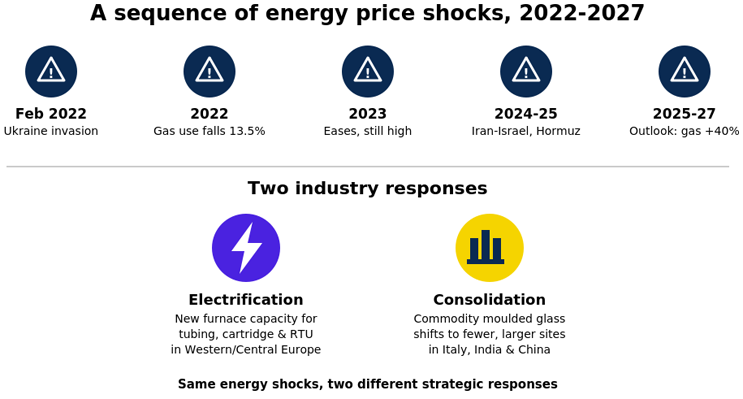
Figure 1: Energy-cost adaption strategies observed across glass manufacturers. Source: Beroe Analysis, compiled from 1, 2, 3, 4, 5: European Commission, Center on Global Energy Policy (Columbia SIPA), S&P Global Commodity Insights, and Bloomberg/HSBC reporting on European gas and energy price trends, 2022–2027.
From 2024 onward, the Middle East became the primary source of price shocks. Iran's missile assaults on Israel in October 2024 drove up oil and gas prices merely because markets factored in the possibility.4 Then came the Israel-Iran crisis in June 2025, which created a bigger jolt: TTF futures rose as high as 5.7% in a single trading session on fears Iran would close the Strait of Hormuz, a route that transports approximately a fifth of the world's LNG commerce. According to Bloomberg, HSBC predicts that European gas prices would be almost 40% higher than previously expected until 2027.5 For an industry that melts glass around the clock at temperatures as high as 1,700 degrees Celsius and cannot readily halt production, this pattern of rapid, unanticipated increases has arguably been just as disruptive to planning as the original 2022 peak.
Mitigating Soaring Energy Prices
European glass manufacturers have increasingly adopted sustainability practices that also help reduce exposure to high and volatile energy prices.
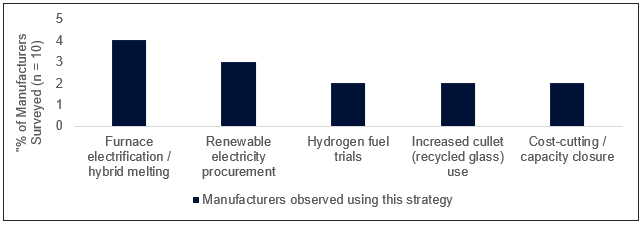
Figure 2: Energy-cost adaptation strategies observed across glass manufacturers. Source: Beroe Analysis based on publicly disclosed company announcements from Ardagh Glass Packaging, AGC Glass Europe, DWK Life Sciences, SCHOTT, O-I Glass, Nipro, and Gerresheimer (references 6, 8, 9, 10).
Sustainability initiatives can significantly reduce energy costs for glass producers, with energy efficiency representing the most effective near-term cost lever. Electrification and the adoption of renewable power are longer-term structural initiatives that can further support cost optimization and decarbonization. Given the stringent quality standards for pharmaceutical glass, furnace efficiency and electrification represent more significant cost levers than simply increasing recycled glass content.
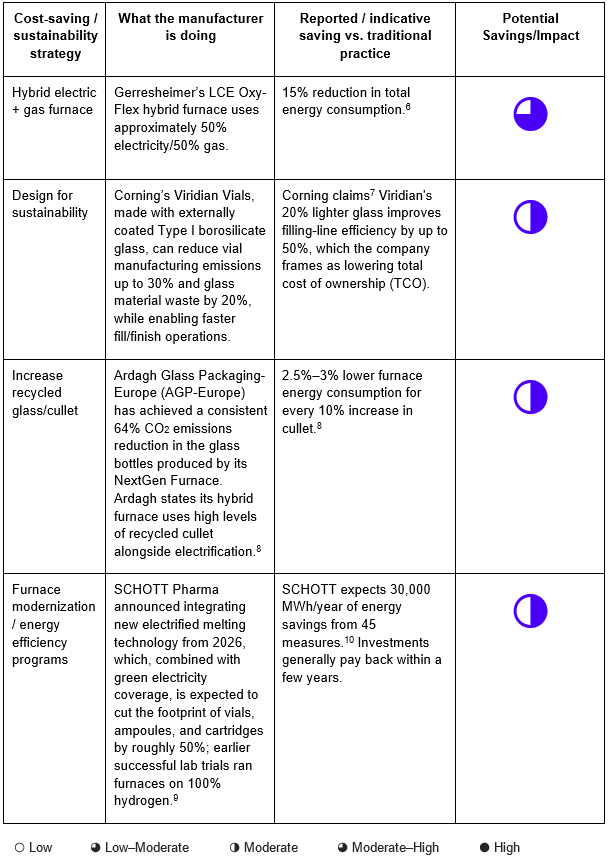
Table 1: Manufacturer examples and cost-saving strategies. Source: Beroe Analysis, compiled from company disclosures cited in references 6, 7, 8, 9, 10.
Case Study: Gerresheimer’ Parallel Bets On Sustainability Investment And Molded Glass Divestment
Gerresheimer provides a relevant case study because it demonstrates the divergence between operational sustainability and strategic portfolio attractiveness.
Between 2023 and 2025, Gerresheimer continued to develop capacity in Germany and the Balkans, including a third expansion in five years at its Wackersdorf plant in 2023, new glass syringe capacity in Skopje, North Macedonia, in December 202411 and a new ready-to-fill vial facility in Wertheim, Germany in October 2025. According to Manufacturing Chemist, Gerresheimer invested over 100 million euros in the two years leading up to mid-2025 on an energy-efficient oxy hybrid furnace at its molded glass facility in Lohr am Main, Germany.6
Then, on August 4, 2025, Gerresheimer announced that it would separate its combined molded glass business, an eight-plant operation spanning Europe, the Americas, and Asia, which was partially formed through the 2024 acquisition of Bormioli Pharma, and pursue a sale so it could focus solely on higher-value pharma and biotech systems and drug delivery devices.12,13
Over the next year, this led to actual closures and moves: According to a WARN Act petition, Gerresheimer announced plans to close its molded glass facility in Chicago Heights, Illinois, and shift production to its Italian and Indian sites.14 It also decided to sell its Ohio-based Centor packaging business and its global Primary Packaging Plastics segment to private equity company Apax Funds for approximately 1.5 billion euros.15,16 On top of that, Gerresheimer opened a new plant in Zhenjiang Dagang, China, in July 2026.17
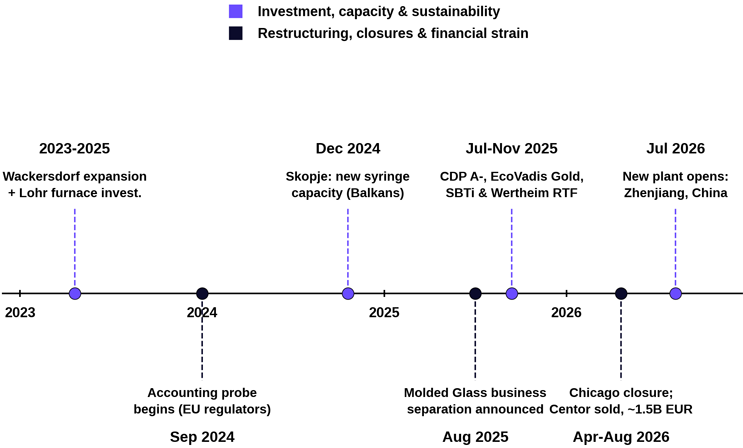
Figure 3: Gerresheimer’s 2023–2026 paradox. Source: Beroe Analysis based on information available in Gerresheimer’s press releases and investor disclosures (see references 6, 11, 12, 13, 14, 15, 16, 17).
All of this cannot be attributed solely to energy costs. Gerresheimer has been under a separate accounting inquiry by European banking regulators since about September 2024. According to the company's own declarations, the divestment was made as a strategic focus decision rather than in response to rising energy costs.13 Despite significant investment in modern, energy-efficient glass manufacturing, the company decided to separate its molded glass business, highlighting how ownership strategy, capital allocation, growth expectations, and manufacturing economics can influence supplier continuity independently of decarbonization progress.
European Policy Support Kept Glass Manufacturers Investing Through The Energy Crisis
Industry bodies like Glass Alliance Europe successfully lobbied the European Commission to classify continuous-process glass manufacturing as a priority sector during potential gas rationing.18
- EU Temporary Crisis and Transition Framework (March 2022) — allowed member states to approve state aid worth roughly €672 billion to affected companies, giving governments the legal basis to intervene quickly.19
- Germany's Decarbonisation of Industry program (BMWK/KEI, through end-2023) — provided direct grants to glass manufacturers such as Ardagh and SCHOTT, funding hybrid and electric furnace conversions that reduced dependence on natural gas.20
- Federal Funding for Industry and Climate Protection (BIK), successor program through 2030 — extended support for electrification and hydrogen adoption in industrial processes.20
- EU Emissions Trading System guideline revisions — set aside €60 billion (2021–2030) to offset higher electricity costs for energy-intensive sectors.19
- Public recognition at EU level — Commission President Ursula von der Leyen named glass as a sector requiring targeted support in her 2022 State of the Union address.18
- Member-state emergency tariffs — including Germany's proposed preferential industrial electricity rate and Greece's payback subsidy scheme for large energy consumers.19
Procurement Teams Should Take Four Practical Lessons From This Analysis
- First, sourcing risk now depends on glass format: molded Type I glass is consolidating, with plants and ownership changing hands, so contracts need strong supply continuity and change-of-control protections.
- Second, tubing, cartridge, and ready-to-use capacity is expanding into newer, lower-cost regions, so buyers should verify each site's quality and regulatory track record directly rather than trusting location and vendor’s brand name.
- Third, energy prices will stay volatile, so multiyear contracts should include indexed or capped energy-surcharge terms.
- Finally, rather than relying solely on a supplier's company-wide ESG score, sustainability claims should be verified at the plant level, considering the actual energy source and furnace technology used to manufacture the buyer's products.
European pharmaceutical glass manufacturing is shifting from an energy-intensive, gas-dependent production model toward a more efficient, electrified, and circular manufacturing model. Rising energy costs initially forced manufacturers to focus on hedging, efficiency, and price pass-through, but these measures are now evolving into longer-term investments in hybrid/electric furnaces, renewable energy, cullet, lightweighting, and digital optimization. As a result, sustainability is increasingly becoming a source of cost competitiveness rather than simply an environmental obligation.
The future European pharma glass manufacturer will likely be less dependent on natural gas, more dependent on renewable electricity, more efficient in its use of raw materials, and increasingly capable of producing lower-carbon glass without compromising pharmaceutical quality. The transition is already visible across the wider European glass industry. FEVE reported in 2026 that more than 150 decarbonization and innovation projects were underway across European container glass, with manufacturers investing more than €600 million annually in electrification, hybrid furnaces, hydrogen, and circular logistics.21
As energy volatility becomes a permanent feature of European manufacturing rather than a temporary shock, pharmaceutical glass manufacturers and procurement teams that treat furnace technology, plant ownership, and energy contracts as strategic variables rather than fixed assumptions will prevail.
References
- European Comission, “Energy prices and costs in Europe,” 2024. [Online]. Available: https://energy.ec.europa.eu/data-and-analysis/energy-prices-and-costs-europe_en.
- Glass-International, “FEVE calls for more realistic climate policy framework,” Glass-International, February 2026. [Online]. Available: https://www.glass-international.com/news/feve-calls-for-more-realistic-climate-policy-framework.
- C. o. G. E. P. a. Columbia, “Anatomy of the European Industrial Gas Demand Drop,” Center on Global Energy Policy at Columbia, March 2024. [Online]. Available: https://www.energypolicy.columbia.edu/publications/anatomy-of-the-european-industrial-gas-demand-drop/.
- H. E. Edwardes, E. Stuart, W. H. Wang and P. Robert, “Iran's missile attack on Israel spikes oil, gas, shipping market risks,” S&P Global, October 2024. [Online]. Available: https://www.spglobal.com/energy/en/news-research/latest-news/natural-gas/100124-factbox-irans-missile-attack-on-israel-spikes-oil-gas-shipping-market-risks.
- Bloomberg, “HSBC: Europe Faces High War-Related Gas Prices Through 2027,” Energy Connects, March 2026. [Online]. Available: https://www.energyconnects.com/news/gas-lng/2026/march/europe-faces-high-war-related-gas-prices-through-2027-hsbc-says/.
- Gerresheimer AG, “Gerresheimer Successfully Completes Investment in State-of-the-Art Glass Production Facility in Lohr,” Gerresheimer AG, May 2025. [Online]. Available: https://www.gerresheimer.com/en/company/news/detail/gerresheimer-successfully-completes-investment-in-state-of-the-art-glass-production-facility-in-lohr.
- S. Polasani, “The Future of Sustainable Pharmaceutical Glass Packaging,” [Online]. Available: https://www.corning.com/worldwide/en/products/pharmaceutical-technologies/viridian/future_of_sustainable_pharma_glass_packaging_Viridian_Vials.html.
- Glass International, “Ardagh Glass Packaging achieves 64% CO2 reduction producing bottles from NextGen Furnace,” Glass International, June 2024. [Online]. Available: https://www.glass-international.com/news/ardagh-glass-packaging-achieves-64-co2-reduction-producing-bottles-from-nextgen-furnace.
- SCHOTT, “Glass production without natural gas: Successful laboratory tests with 100 percent hydrogen,” SCHOTT, July 2023. [Online]. Available: https://www.schott.com/en-in/news-and-media/media-releases/2023/glass-production-without-natural-gas-successful-laboratory-tests-with-100-percent-hydrogen.
- D. Savastano, “Saving 30,000 MW Hours of Energy,” Ink World, January 2024. [Online]. Available: https://www.inkworldmagazine.com/breaking-news/effinetschott-saving-30000-mw-hours-of-energy/.
- Gerresheimer AG, “Gerresheimer builds new production capacities for glass syringes at Skopje site,” Gerresheimer AG, December 2024. [Online]. Available: https://www.gerresheimer.com/en/company/press-events/detail/gerresheimer-builds-new-production-capacities-for-glass-syringes-at-skopje-site.
- PharmaIndustrial - India, “Gerresheimer to Divest Moulded Glass Business, Sharpens Focus on Pharma and Biotech Solutions,” PharmaIndustrial - India, August 2025. [Online]. Available: https://www.pharmaindustrial-india.com/news/gerresheimer-to-divest-moulded-glass-business-sharpens-focus-on-pharma-and-biotech-solutions.
- Gerresheimer AG, “Q2/H1 2025 Financials Report,” Gerresheimer, [Online]. Available: https://www.gerresheimer.com/fileadmin/user_upload/user_upload/gerresheimer/ir/downloads
/presentations/2025/Q22025-Analyst-presentation-Protected.pdf. - D. R. Sheffield, “Chicago Heights Pharma Glass Plant Shutters, 172 Jobs Axed As Work Heads Overseas,” Hoodline, April 2026. [Online]. Available: https://hoodline.com/2026/04/chicago-heights-pharma-glass-plant-shutters-172-jobs-axed-as-work-heads-overseas/.
- Gerresheimer AG, “Gerresheimer is selling Centor and its global Primary Packaging Plastics business to Apax Funds,” Gerresheimer AG, July 2026. [Online]. Available: https://www.gerresheimer.com/en/customer/company/news/detail/gerresheimer-is-selling-centor-and-its-global-primary-packaging-plastics-business-to-apax-funds
- M. Rachal, “Gerresheimer selling certain assets to private equity,” PackagingDive, July 2026. [Online]. Available: https://www.packagingdive.com/news/gerresheimer-sells-centor-primary-packaging-plastics-apax/826460/.
- Gerresheimer AG, “Gerresheimer Starts Operations at New Plant in Zhenjiang Dagang, China,” Gerresheimer AG, July 2026. [Online]. Available: https://www.gerresheimer.com/en/customer/company/news/detail/gerresheimer-starts-operations-at-new-plant-in-zhenjiang-dagang-china.
- Glaas Online, “Glass Alliance Europe: Glass industry needs urgent EU support measures,” Glass Online, November 2022. [Online]. Available: https://www.glassonline.com/glass-alliance-europe-glass-industry-needs-urgent-eu-support-measures/.
- G. Sgaravatti, S. Tagliapietra and Z. Georg, “Adjusting to the energy shock: the right policies for European industry,” Bruegel, May 2023. [Online]. Available: https://www.bruegel.org/policy-brief/adjusting-energy-shock-right-policies-european-industry.
- KEI, “Funding programme 'Decarbonisation of Industry',” December 2023. [Online]. Available: https://www.klimaschutz-industrie.de/en/funding/decarbonisation-of-industry/.
- “Accelerating the European container glass industry’s energy transition: FEVE releases 2025 decarbonisation blueprint,” FEVE - The European Container Glass Federation, March 2026. [Online]. Available: https://feve.org/accelerating-the-european-container-glass-industrys-energy-transition-feve-releases-2025-decarbonisation-blueprint/.
About The Author:
 Anitha Ramu is a senior research analyst at Beroe Inc. with over four years of experience in market research and consulting. She has supported global clients in supplier outsourcing, category management, and R&D strategy by conducting market sourcing studies, supplier assessments, and competitive analyses. She is passionate in transforming complex data into actionable recommendations and providing rapid strategic insights for both global and regional business needs.