
Use Of AI In FDA Inspection Activities: Strategies For Effective Preparation
By David Elder, ELIQUENT Life Sciences

Are you ready? FDA has begun to implement the use of artificial intelligence (AI) in its operations, including review of clinical study data, marketing authorization applications, signals identified through reporting requirements, and entries offered for import, as well as in advance of and during certain inspections or remote regulatory assessments (RRAs).
The agency created a new consolidated platform called Harmonized AI & Lifecycle Operations for Data (HALO) and an internal AI tool called ELSA.1 In addition to modernizing its operations, FDA is also overseeing how the industry has begun its adoption of AI in various regulated activities,2 including product and process development, control and analysis of manufacturing and quality operations, and evaluation of clinical and commercial product performance and safety signals.
This first article focuses on FDA’s use of ELSA during inspection activities.3 With insight shared into how we expect AI to be used, the advice provided here helps companies get ready and be better prepared to manage AI-supported inspections. When a company replicates the approach during internal audits or mock inspections, inspection readiness is greatly enhanced and, more importantly, the company improves its detection of signals to further support product quality, patient safety, and regulatory compliance.
ELSA was developed in-house at FDA and it resides behind the agency’s firewall. While ELSA is not commercially available, it operates in a similar way to any other large language model AI. FDA uses ELSA to support the thoroughness and efficiency of inspections by analyzing information and comparing information from multiple sources.
The benefit of use is derived through a feedback loop process composed of: data and information inputs, querying the AI tool with the right initial questions, assessing the outputs and re-querying the tool with reconfigured and follow-up questions, and continuing until ultimately generating relevant outputs. An output would not directly constitute a violation per se but would rather represent signals that require review, evaluation, and investigation. Use of AI enables an FDA investigator to identify signals more quickly and comprehensively than previously used manual and computer-aided inspection tactics.
Expectations For Use
The AI tool could be queried to analyze a discrete record and generate an evaluation, such as whether the root cause determination in an out-of-specification investigation record was plausible and supported with evidence. While an experienced FDA investigator can perform a similar evaluation in a relatively similar time, the combination of AI with experienced human involvement creates a new standard. The true power of the AI tool, however, becomes more fully realized when it is nourished with meaningful data from various data sources, queried and re-queried with thoughtful directions to analyze the data, and when it produces outputs that are ripe for further investigation. FDA will have its own data available but, similar to FDA’s initial requests at the start of an inspection, data and information from the company’s information systems will typically include:
- complaint data: Excel database (with key data fields included)
- investigation data: Excel database(s) for deviations, non-conformances, out-of-specification/trend/expectation, failures, etc. (with key data fields included)
- change control data: Excel database (with key data fields included)
- CAPA data: Excel database (with key data fields included)
- risk management information: often FMEA or FMECA spreadsheets along with product-specific risk analyses (where indicated)
- key standard operating procedures and work instructions.
The available FDA data, to further feed the AI tool and to augment the company’s data, may include:
- data and information from FDA’s complaint or adverse event data systems
- data and information from FDA’s Field Alert Report (for NDA/ANDA drugs) or Biological Product Defect Report (for BLA drugs/biologics) systems
- data and information from FDA’s Recall Enterprise System
- information from marketing authorization applications (e.g., NDA, ANDA, BLA, PMA, 510(k)) and associated reports or supplements, including product or process changes, performance claims, labeling
- information from previous FDA inspections or available from other health authorities.
Development Of The Thoughtful Queries Is Where Art Meets Science
FDA officials will use their real-life intelligence, their experience, and their expertise to develop standard AI queries along with customized queries that are most appropriate to the current inspection activities. The queries may focus on data from a specific database and data that cuts across multiple databases and information sources (company-generated or FDA-generated) that could identify connections or signals that were heretofore unrecognized.
Examples of standard queries are shown in Table 1 below to simply highlight the types of queries that could be identified; these examples are illustrative of the thinking only.
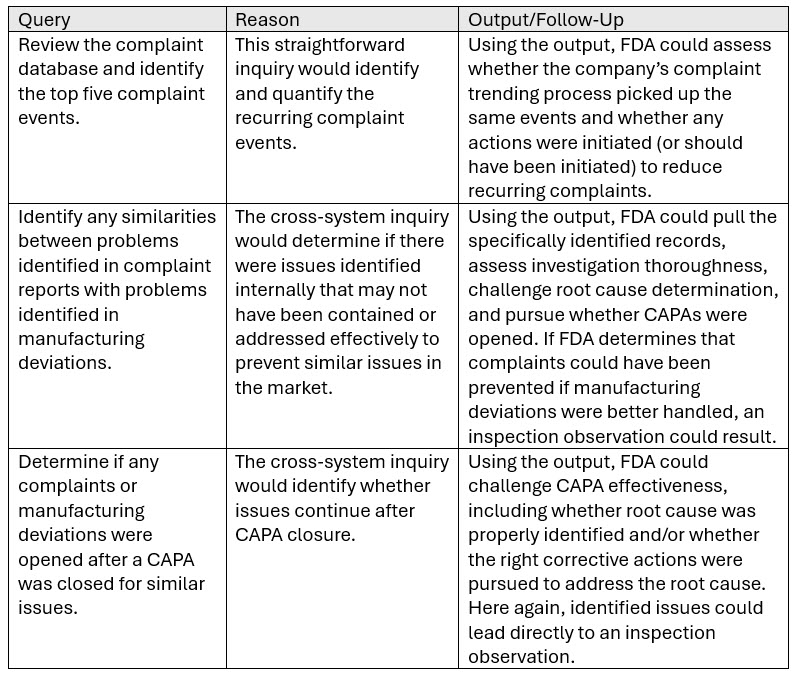
Table 1: Examples of Potential Standard Queries
The standard queries in Table 1 could be relevant during any FDA inspection. There is nothing new about the agency having interest in assessing this data, with an interest in these outputs. What’s new is the further evolution of FDA’s inspection tactics to use an AI tool to generate signals more quickly and thoroughly than through previous tactics (e.g., manual review, data sorting, keyword searches, pivot tables).
To showcase use of inspection-/situation-dependent queries, let’s use the concern of “foreign material in sterile packaging” as an illustrative example. This concern could arise during an inspection — as an output of a standard AI query, from review of operations, deviations, testing, or complaints — or could have been the trigger of a for-cause inspection due to a Field Alert Report or a recall. Examples of inspection-/situation-dependent queries are shown in Table 2 below.
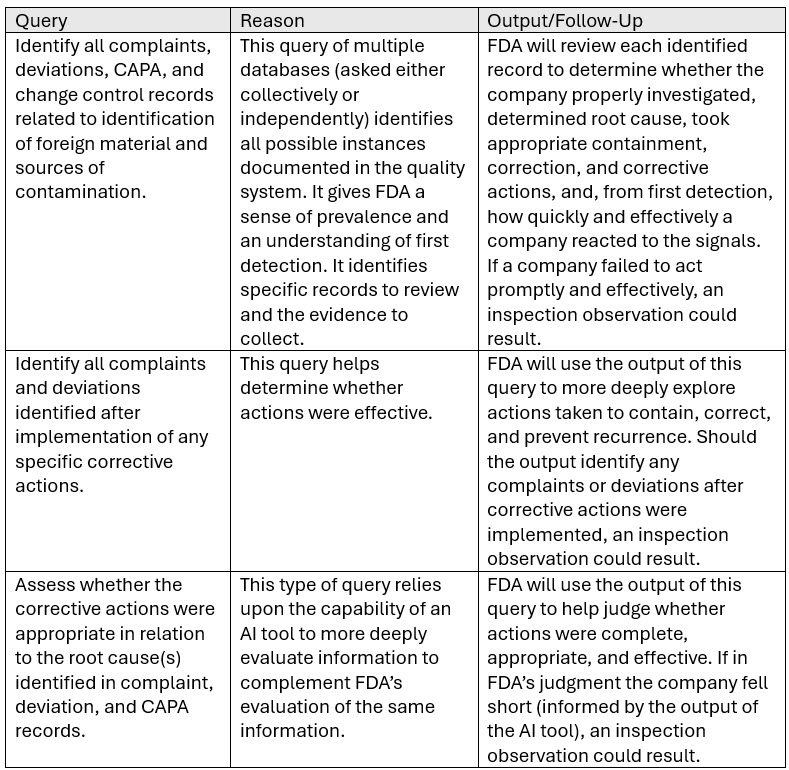
Table 2: Examples of an inspection-/situation-dependent queries (foreign material in sterile packaging)
Recommendations To Prepare For And Manage Inspections
FDA’s use of an AI tool is an inspection tactic that is here now and is here to stay. While currently in its infancy, its use will only evolve. With no benefit derived from resisting, ignoring, or feeling victimized by its use, the best logical path forward is to qualify an AI tool for company use, develop user competency in its functionality, and adapt the internal systems and approaches to embrace it.
Inspection Preparation
A long-standing rule of thumb is that an inspection should never find anything in a company’s data that the company didn’t already know. To this end, using a qualified AI tool to supplement data trending and analysis within and across sources of quality data is encouraged. These AI-supported analyses, supported with appropriate human oversight, should be embedded within existing quality management systems and become reported in ad hoc or standing committees and meetings, such as: Quality Management Review, Quality Council, Complaint Review Board, CAPA Review Board. When reported through such channels, it remains critically important to document the evaluation, decisions, and actions that result from these enhanced means of more proactive signal detection.
Further to preparation, a company’s internal audit/self-assessment programs should be upgraded to mandate use of a qualified AI tool in preparation and operationalization of activities. This approach enhances a company’s ability to find and fix its own issues while further supporting inspection readiness by adopting an audit approach that more closely simulates an inspection approach.
Inspection Management
Inspections are initiated for one of three primary reasons: routine surveillance, pre-approval, or directed/for-cause. AI-supported approaches could manifest during each type of inspection. Within the first few hours of an inspection, a company should know the reason and be able to predict the areas of focus. To augment all that was completed in preparation, a company must be able to react in real time to facilitate inspection management and strive to mitigate downside risk.
The real-time reaction should include supplying the company’s AI tool with the same sources of information requested by the inspection official. With knowledge of the inspection reason and areas of focus, experienced company officials can query their AI tool to identify the same types of signals that the inspection officials may identify. With that information, the company can get a jump on evaluating any such signals, obtaining relevant records and information, and preparing company officials to answer any inspection inquiries more accurately, thoroughly, and promptly than would otherwise be possible. Doing so could preclude misunderstandings, demonstrate awareness and understanding, and resolve potential areas of concern at earlier stages of the inspection.
Despite all the best efforts in preparation and management, inspection observations may still arise if areas of noncompliance are identified. The qualified AI tool can again be used to more promptly evaluate risk, impact, and scope and to inform the company’s approach to containment, correction, and corrective action. An initial strategy for resolution of the inspection observation could be available to discuss during the inspection and at the inspection close-out meeting. Initiating and communicating actions effectively could further mitigate compliance risk after the inspection.
Conclusion
FDA’s inspection tactics continue to evolve and the agency’s adoption of ELSA as its AI tool is just the next stage of evolution. The outputs are only as reliable as the data that inform it and the individuals who apply it — FDA’s use of AI becomes empty if not used in conjunction with the real-life intelligence FDA brings to its inspections. When implemented with adequate oversight and critical thinking, a company’s use of its own properly qualified AI tool will strengthen inspection readiness and support more effective inspection management. Its greatest value, however, lies in its ability to enhance a company’s capability to identify and evaluate signals to better ensure product quality, patient safety, and regulatory compliance, while maintaining vigilant human oversight.4 Ultimately, organizations that remain committed to these priorities will continue to achieve successful inspection outcomes.
References
- https://www.fda.gov/news-events/press-announcements/fda-expands-ai-capabilities-and-completes-data-platform-consolidation
- https://www.fda.gov/regulatory-information/search-fda-guidance-documents/considerations-use-artificial-intelligence-support-regulatory-decision-making-drug-and-biological
- FDA conducts inspections through general procedures outlined in the Investigations Operations Manual and specific procedures associated with inspection-specific categories, such as FDA’s newly released compliance programs for Pre-license and Pre-approval Inspections of original and supplemental biologics license applications regulated by FDA’s Center for Drug Evaluation and Research (Compliance Program CP7346.832m) and Medical Device Inspections (Compliance Program CP7382.850). https://www.fda.gov/media/191983/download?attachment and https://www.fda.gov/media/80195/download
- Among the few actions to date, Warning Letter #320-26-58 (April 2026), citing a company for “inappropriate Use of Artificial Intelligence in Pharmaceutical Manufacturing” received significant public attention. https://www.fda.gov/inspections-compliance-enforcement-and-criminal-investigations/warning-letters/purolea-cosmetics-lab-722591-04022026
About The Author:
 David Elder is a principal at ELIQUENT Life Sciences. He is a 23-year veteran of the FDA, where he served as a senior executive — director of the Office of Enforcement and director of the Office of Regional Operations — with prominent roles in domestic and foreign inspections, recalls and emergencies, and compliance actions involving hundreds of situations. Earlier in his FDA career, he served as an investigator, compliance officer, and director of compliance in the Boston District Office. At ELIQUENT, Elder provides strategic guidance and support to pharmaceutical and medical technology companies in areas of quality and compliance.